Decoding the Digital Dialogue: Our Candid Take on AI Chatbots
A friendly exploration of the marvels and mishaps of our algorithmic companions.
Executive Summary: Our Love-Hate Relationship with AI
AI chatbots have quickly transitioned from futuristic concepts to everyday tools, weaving their way into our work, learning, and even leisure. They promise unprecedented efficiency and creativity, yet often deliver moments of head-scratching frustration. This post dives into the heart of this paradox, using a structured framework to articulate precisely what delights us and what still leaves us wishing for more. We’ll explore their incredible utility, point out their current shortcomings, and offer a roadmap for how we can better interact with and develop these powerful digital partners.
Problem Framing: The Double-Edged Sword of AI Interaction
The ubiquity of AI chatbots presents a unique challenge: they are simultaneously brilliant and bewildering. One moment, they’re streamlining complex tasks with ease; the next, they’re providing generic, unhelpful, or even factually incorrect information. This inconsistent experience highlights a critical need to systematically evaluate their performance beyond superficial impressions. How do we make sense of this fluctuating utility?
The Hype vs. The Reality
Initial reactions to new AI models often swing between awe and skepticism. We marvel at their capacity to generate human-like text, code, and even images, but soon encounter their limitations. This gap between the advertised potential and the lived experience forms the core of our exploration.
Navigating the User Experience Paradox
For users, the interaction can feel like a lottery. Is this the prompt that unlocks genius, or the one that leads to a polite but utterly useless response? Understanding the underlying factors that contribute to these varied outcomes is crucial for effective engagement and future development.
Our “Chatbot Content & Experience” (CCE) Framework
To systematically dissect our feelings about AI chatbots, we’ve developed the “Chatbot Content & Experience” (CCE) framework. This simple yet powerful model helps us categorize and understand the different dimensions of AI chatbot performance, guiding our discussion of both their strengths and weaknesses.
C1: Clarity & Conciseness – The Foundation of Understanding
This dimension focuses on how well the chatbot understands our queries and how clearly and concisely it articulates its responses. It covers accuracy, relevance, and the ability to cut through noise to deliver precise information.
- Input Interpretation: Does it grasp the nuance of my prompt?
- Output Precision: Is the answer direct, relevant, and free from ambiguity?
- Factual Accuracy: Is the information reliable and verifiable?

C2: Creativity & Cohesion – Beyond the Basics
This aspect evaluates the chatbot’s ability to generate novel ideas, synthesize complex information into coherent narratives, and produce outputs that exhibit originality and structural integrity. It’s about moving beyond mere regurgitation to true generative capacity.
- Idea Generation: Can it brainstorm, suggest unique angles, or offer creative solutions?
- Narrative Flow: Are its longer outputs well-structured, logical, and engaging?
- Stylistic Adaptability: Can it adjust its tone and style to suit different contexts or personas?
E: Empathy & Engagement – The Human-Like Touch (or Lack Thereof)
This dimension explores the chatbot’s interactive qualities, its capacity for conversational flow, and how it handles user emotions (or the perception of them). It’s about the overall “feel” of the interaction, including its patience, error recovery, and ability to maintain context.
- Conversational Continuity: Does it remember prior turns in the conversation?
- Patience & Politeness: How does it handle repetitive questions or frustration?
- Error Handling: How gracefully does it admit limitations or correct mistakes?
Implementation Plan: Applying the CCE Framework to Our Likes & Dislikes
Now, let’s put our CCE Framework to work, detailing the specific aspects of AI chatbots that we either adore or find frustrating. This section moves from strategic framing to tactical observations.
What We Absolutely Love (The “Likes”)
Clarity & Conciseness (C1): Instant Information & Synthesis
- Lightning-Fast Information Retrieval: Need to understand a complex topic quickly? Chatbots excel at distilling vast amounts of information into digestible summaries. It’s like having a super-fast research assistant at your fingertips.
- Explaining Complex Concepts: From quantum physics to obscure legal terms, they can break down intricate subjects into simpler language, making learning accessible for everyone.
- Data Summarization: Feeding a chatbot a lengthy document and getting a coherent summary in seconds is a game-changer for productivity.
Creativity & Cohesion (C2): Brainstorming & Content Generation
- Idea Generation Powerhouse: Struggling with writer’s block? Chatbots are fantastic for brainstorming blog post ideas, marketing slogans, or even creative story plots. They offer fresh perspectives you might not have considered.
- Drafting First Passes: For emails, articles, or code snippets, generating a solid first draft allows us to focus on refining rather than starting from scratch. It drastically cuts down initial effort.
- Stylistic Transformations: Need to rewrite a formal email into a friendly text message, or vice versa? Chatbots can adapt tone and style with impressive fluidity.
Empathy & Engagement (E): Accessibility & Patience
- Always Available, Infinitely Patient: Unlike human assistants, chatbots don’t get tired or annoyed. They’re available 24/7, ready to answer the same question for the tenth time without a hint of frustration. This accessibility is invaluable.
- Breaking Down Language Barriers: The ability to translate and communicate across languages instantly fosters better global understanding and collaboration.
- Personalized Learning & Support: For specific questions or tutoring, they can offer tailored explanations and practice, adapting to individual learning paces.
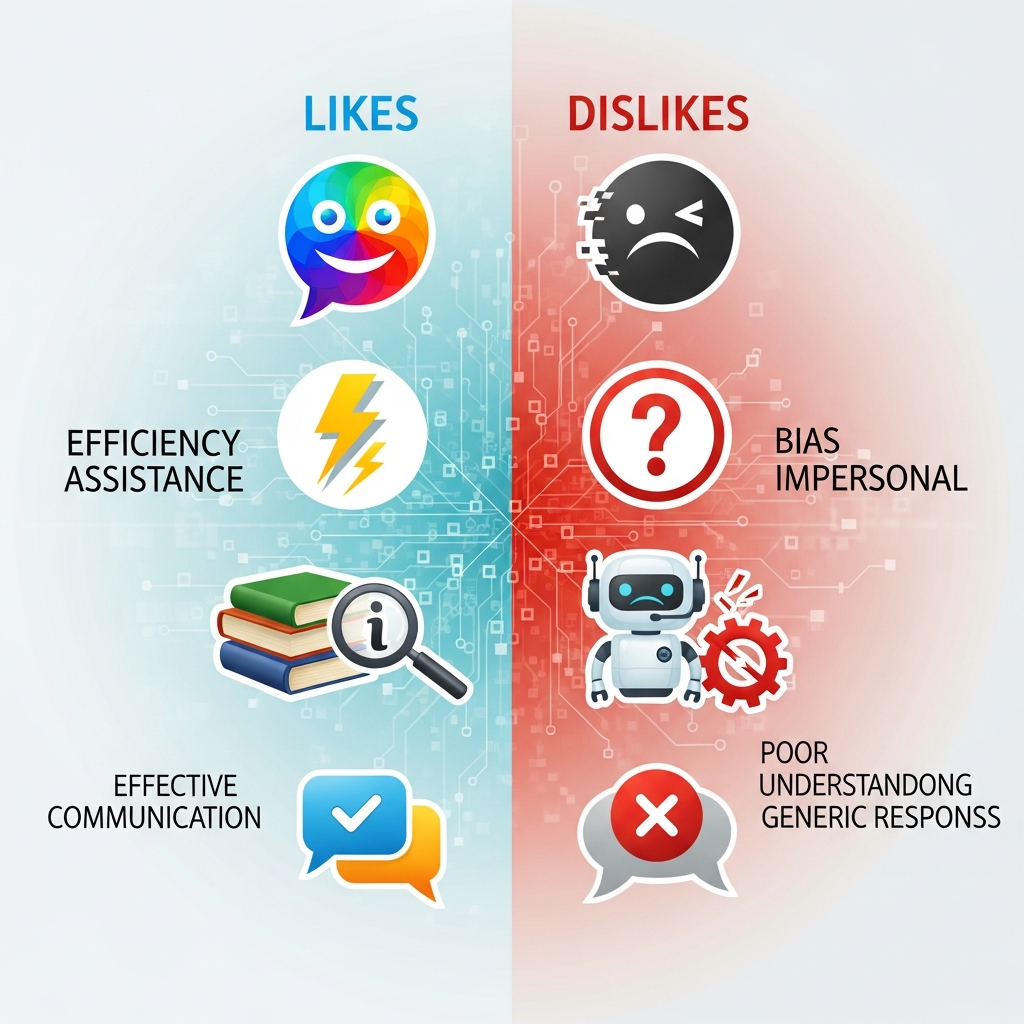
What Still Makes Us Scratch Our Heads (The “Dislikes”)
Clarity & Conciseness (C1): Hallucinations & Misinterpretations
- The “Hallucination” Factor: The most significant drawback is their tendency to confidently present incorrect or fabricated information as fact. This requires constant vigilance and fact-checking.
- Misunderstanding Nuance & Context: While good at surface-level understanding, chatbots often miss subtle cues, sarcasm, or deep contextual implications, leading to irrelevant or unhelpful responses.
- Lack of Real-World Understanding: They don’t truly “know” the world; they predict the next best word. This becomes evident when asked about subjective experiences or physical realities.
Creativity & Cohesion (C2): Generic Output & Lack of Nuance
- Generic & Formulaic Responses: Without very precise prompting, outputs can often feel bland, repetitive, and lack a unique voice or truly original thought. It’s “AI-speak.”
- Inability to Truly Innovate: While they can combine existing ideas creatively, generating genuinely groundbreaking concepts or profound artistic expressions remains beyond their current capabilities.
- Struggles with Long-Form Cohesion: For very long or complex documents, maintaining consistent quality, factual accuracy, and thematic cohesion throughout can be challenging, leading to disjointed sections.
Empathy & Engagement (E): Repetitive Responses & Emotional Blind Spots
- Repetitive Phrasing & Boilerplate: Over time, interacting with the same chatbot can reveal recurring linguistic patterns and stock phrases, making conversations feel less natural and more robotic.
- Emotional Blind Spots: While they can process sentiment, they lack true empathy or emotional intelligence. Their responses to sensitive topics can feel cold, detached, or inappropriately cheerful.
- Limited Problem-Solving for Ambiguity: When faced with genuinely ambiguous or subjective user requests, they often default to asking for clarification rather than offering creative interpretative solutions, stalling the conversation.
Risks and Mitigations: Taming the AI Beast Responsibly
While AI chatbots offer immense potential, their widespread adoption comes with inherent risks. Strategic deployment requires proactive mitigation strategies to ensure ethical, safe, and effective use.
Risk 1: Over-Reliance & Critical Thinking Decay
Excessive dependence on AI for analysis and decision-making can diminish human critical thinking skills and the ability to perform tasks independently.
- Mitigation: Human Oversight & Verification: Always treat AI outputs as a starting point, not a final answer. Encourage critical review, fact-checking, and the application of human judgment.
- Mitigation: Prompt Engineering Training: Educate users on how to craft effective prompts that encourage AI to explain its reasoning or provide diverse perspectives, rather than just a single answer.
Risk 2: Bias & Misinformation Amplification
AI models are trained on vast datasets that can contain inherent biases, leading to biased outputs. Their “hallucination” capability also poses a significant risk for spreading misinformation.
- Mitigation: Source Verification Protocols: Implement strict policies requiring users to verify information from reputable, independent sources, especially for critical decisions or public-facing content.
- Mitigation: Diverse Data & Ethical AI Development: Push for continued research and development into training AI on more diverse and ethically curated datasets to reduce inherent biases.
Risk 3: Data Privacy & Security Concerns
Interacting with chatbots often involves sharing information, raising concerns about data privacy, security breaches, and how personal or proprietary data is used and stored.
- Mitigation: Data Anonymization & Confidentiality Guidelines: Establish clear guidelines for users to avoid inputting sensitive personal, financial, or proprietary company information into public-facing AI chatbots. Utilize enterprise-grade, secure AI solutions where available.
- Mitigation: Regular Audits & Compliance: Companies deploying AI chatbots should conduct regular security audits and ensure compliance with relevant data protection regulations (e.g., GDPR, CCPA).
Conclusion: A Symbiotic Future with AI
Our journey through the likes and dislikes of AI chatbots, guided by the CCE framework, reveals a powerful truth: they are not perfect, but they are undeniably transformative. The key to unlocking their full potential lies not in blind acceptance or outright rejection, but in a balanced, informed approach.
We cherish their ability to augment our intelligence, accelerate our workflows, and inspire new ideas. We remain wary of their current limitations, especially regarding factual accuracy and true creativity, understanding that these are areas for ongoing improvement and careful human oversight.
Ultimately, the future of AI chatbots isn’t about replacing human intellect, but about forging a symbiotic relationship where their strengths compensate for our weaknesses, and our human judgment guides their incredible, yet still nascent, capabilities. Let’s continue to engage with them thoughtfully, critically, and with a healthy dose of friendly curiosity.