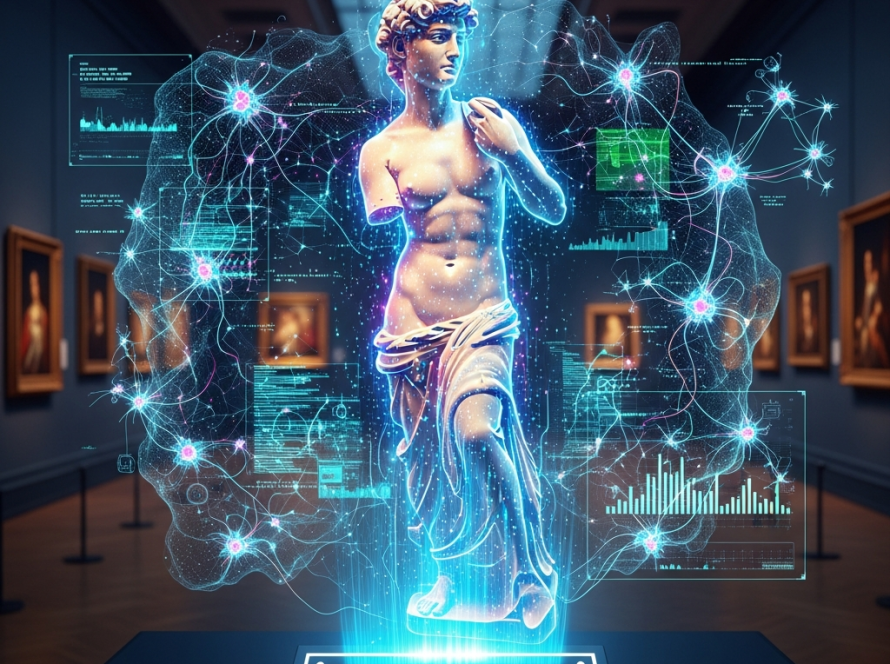
Welcome to the Past of AI!
Have you ever wondered where the idea of “machine intelligence” actually came from? It feels like AI just burst onto the scene recently, but its history is surprisingly long and fascinating! It’s not some brand-new magic, but a journey spanning centuries of human curiosity.
Let’s take a friendly stroll through time and discover the real roots of what we now call Artificial Intelligence. You might be surprised by how old some of these “new” ideas really are!
The Early Dreamers and Their Machines
Long before computers, people dreamed of intelligent machines. Ancient Greek myths told tales of automatons like Talos, a giant bronze man guarding an island. Philosophers debated the nature of thought and whether machines could ever replicate it.
Fast forward to the 19th century, and we meet Charles Babbage and Ada Lovelace. Babbage designed the Analytical Engine, a blueprint for a mechanical computer, and Lovelace, seeing its potential beyond just numbers, described how it could process more than just calculations – she’s often called the first computer programmer!
From Logic to Learning: The Birth of AI
The real conceptual spark for modern AI came in the mid-20th century. Alan Turing, a brilliant mathematician, proposed the “Turing Test” in 1950, suggesting a way to determine if a machine could exhibit intelligent behavior indistinguishable from a human. This really got people thinking.
Then, in 1956, a pivotal summer workshop at Dartmouth College brought together leading researchers. It was here that the term “Artificial Intelligence” was officially coined. Early AI focused heavily on symbolic reasoning and expert systems, trying to program machines with rules derived from human knowledge. However, progress was slow, leading to periods dubbed “AI winters” where funding and interest waned.
The Rise of Data and Neural Networks
AI didn’t stay in the cold forever! The late 20th and early 21st centuries saw a massive resurgence. Why? A few key things happened: we got much more computational power, vast amounts of data became available, and new algorithms breathed life into old ideas.
Machine Learning (ML), especially techniques like neural networks, became incredibly powerful. Instead of manually programming every rule, machines could now learn from data. This led to breakthroughs in areas like image recognition, speech processing, and natural language understanding, bringing us closer to the AI we interact with today.
Practical Insights: What This History Teaches Us Today
Looking back, we can learn a lot. Firstly, AI has always had its cycles of hype and disappointment. It’s a reminder that true progress often takes time and isn’t always linear. Secondly, AI is not magic; it’s a blend of mathematics, computer science, engineering, and even philosophy.
Understanding this history helps us appreciate the complexity and challenges involved. It encourages us to be curious, ask questions, and think critically about the capabilities and limitations of AI, rather than viewing it as an all-powerful entity.
The Journey Continues
From ancient myths to modern supercomputers, the quest for machine intelligence has been a fascinating human endeavor. It’s a story of big dreams, hard work, and persistent innovation.
The journey of AI is far from over. By understanding where we’ve come from, we’re better equipped to participate in the exciting future of machine intelligence. Keep exploring!